There exists a place where the earth itself seems to have taken a deep, geological breath and held it, creating a sprawling spine of stone and sky that divides a continent. This is the Rocky Mountains, a name that barely scratches the surface of its reality. To speak of a journey through them is not to speak of a simple vacation; it is to speak of a pilgrimage into the heart of raw, untamed beauty, a passage that challenges the body and expands the spirit. It is a traverse not just of miles, but of perspectives.
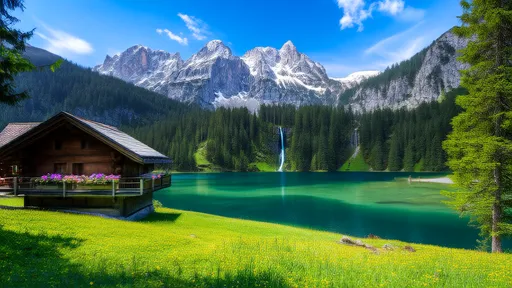
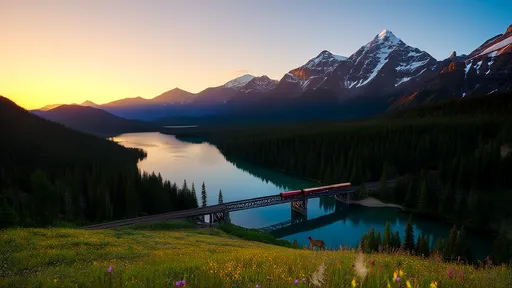
The journey often begins in the northern reaches, perhaps in the Canadian Rockies, where the mountains feel younger, sharper, more aggressively sculpted by ice. Here, the air carries a crisp, pine-scented chill that is uniquely Canadian. Places like Banff and Jasper are not just towns; they are portals. Driving the Icefields Parkway is an experience that redefines the very concept of a road trip. This is not a route designed merely to get you from point A to point B. It is a 232-kilometer-long gallery of natural masterpieces, where every turn in the road unveils a new exhibition. The glaciers, like the Athabasca, are not distant, white smudges on a faraway peak. They are immense, flowing rivers of ancient ice that crawl down to meet the road, their blue crevasses glowing with an otherworldly light. The lakes—Lake Louise, Moraine Lake, Peyto Lake—are the jewels of this northern realm. Their colors seem impossible, a turquoise so vivid and milky that it looks as though the mountains have melted their very essence into the water. It is a color born of glacial flour, rock ground to a fine powder by the immense weight of ice, suspended in the meltwater to refract the sunlight in a way that defies belief.
As one moves south, crossing the invisible border into the American Rockies, the character of the mountains shifts. In Montana, the landscape opens into vast, sweeping valleys flanked by rugged, forested slopes. This is Big Sky country, a land that feels wilder, more remote, and somehow older. The history here is palpable, etched not just in the rocks but in the lore of the American West. This is the domain of Glacier National Park, a place whose very name is a testament to its icy architects. Driving the Going-to-the-Sun Road is an act of faith and engineering, a narrow ribbon of pavement carved precariously into the cliffsides. From the passenger window, the world drops away into dizzying depths, while waterfalls cascade from snowfields still clinging to the heights in midsummer. The wildlife here is not a spectacle put on for tourists; it is a part of the fabric of the place. A grizzly bear foraging for berries in a distant meadow, a herd of bighorn sheep nonchalantly blocking the road, their curled horns a symbol of rugged endurance. The air is filled with the scent of subalpine fir and the sound of wind sweeping down from the Continental Divide. This is a land that demands respect, a reminder that humanity is merely a guest in this ancient kingdom of stone and ice.
Further south, in Wyoming, the Rockies reveal one of their most dramatic and iconic faces: the Tetons. Unlike most mountain ranges that rise gradually from foothills, the Tetons erupt from the flat floor of Jackson Hole in a sudden, spectacular, and sheer vertical thrust. There are no gentle introductions here. The mountains stand as a stark, granite wall, their jagged peaks cutting into the sky like the serrated teeth of a great stone saw. The Snake River winds its way through the valley below, its silty, meandering waters reflecting the majestic panorama. At dawn, the first rays of sun ignite the highest peaks in a blaze of alpenglow, a fleeting, fiery spectacle that feels like a private blessing for those awake to witness it. This landscape is one of dramatic contrasts—the brutal, angular rock faces against the soft, fluid lines of the river; the silent, permanent mountains against the transient, honking flocks of migrating geese. It is a place that speaks of cataclysmic geological forces, of faults and uplifts that are still, geologically speaking, active and alive.
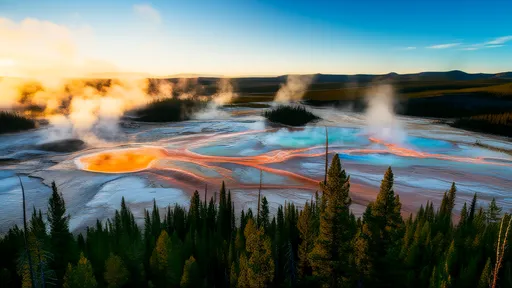
No traverse of the American Rockies would be complete without bowing before the throne of Yellowstone. While often associated with the Tetons, Yellowstone is a world unto itself, a vast, volcanic plateau that sits atop one of the largest supervolcanoes on Earth. This is not a landscape of serene beauty, but one of primal, bubbling, steaming power. The ground itself feels thin here, a fragile crust over a roiling cauldron. Geysers like Old Faithful perform their predictable, yet awe-inspiring, hydraulic ballet, shooting columns of superheated water and steam high into the crisp mountain air. Multicolored hot springs, such as the Grand Prismatic Spring, create psychedelic pools of vibrant orange, green, and blue, their colors a result of heat-loving bacteria that thrive in the extreme conditions. The smell of sulfur, the hiss of steam vents, the gurgle of mud pots—it is a symphony of the subterranean. This is a raw, unfiltered look at the planet's inner workings, a humbling reminder that the ground beneath our feet is anything but solid and permanent.
Crossing into Colorado, the Rockies reach their zenith, both in altitude and in the sheer concentration of towering peaks. This is the realm of the Fourteeners, mountains that soar above 14,000 feet. The air here is thin and sharp, and the sky seems closer, a deeper, more intense shade of blue. The San Juan Mountains in the southwest are often called the "Switzerland of America," with their craggy peaks, wildflower-carpeted basins, and remnants of a booming, and then busted, mining history. Ghost towns like Animas Forks stand as silent, weathered sentinels, their crumbling log structures telling stories of dreams dug from the hillsides. Further north, the Maroon Bells near Aspen are perhaps the most photographed mountains in North America, their bell-shaped, maroon-colored peaks perfectly reflected in the still waters of Maroon Lake. But a photograph can never capture the profound silence of this place at sunrise, broken only by the chirp of a pika or the whisper of the wind through the aspen groves, their golden leaves trembling like a million tiny coins.
The true essence of a Rocky Mountain traverse, however, is not found in any single vista, park, or peak. It is found in the spaces between. It is in the feeling of smallness one experiences when standing on a high pass, watching a summer thunderstorm march across the endless ranges below. It is in the profound quiet of a subalpine forest, where the only sound is the crunch of your own boots on the trail and the rhythm of your own breathing. It is in the unexpected encounters—a moose and her calf wading through a willow thicket, a golden eagle riding a thermal updraft, the startling brilliance of a columbine flower growing from a crack in a granite boulder. This journey teaches a different kind of geography, one not of names and borders, but of light, air, and scale. The light here has a quality unlike anywhere else, at once sharp and soft, illuminating the landscape with a clarity that feels almost supernatural.
To drive, hike, or simply be in the Rockies is to engage in a continuous, silent dialogue with the wild. It is a conversation that forces you to shed the noise and haste of modern life and listen to a much older, slower, and more enduring rhythm. The mountains do not care for human schedules or anxieties. They operate on a timescale of glaciers and tectonic shifts. This journey leaves an indelible mark on the soul. It is a feeling you carry back with you—the memory of that high, clean air, the vastness of the skies, the solid, reassuring presence of ancient rock. It is the understanding that there are still places in this world that are grand, powerful, and fundamentally untamable. The Rockies are more than a mountain range; they are a state of mind, a beautiful, brutal, and breathtaking reminder of our place in a wondrously vast and wild world.

By /Aug 4, 2025
By /Nov 7, 2025
By /Nov 7, 2025
By /Nov 7, 2025
By /Nov 7, 2025
By /Nov 7, 2025
By /Nov 7, 2025
By /Nov 7, 2025
By /Aug 4, 2025
By /Nov 7, 2025
By /Nov 7, 2025
By /Nov 7, 2025

By /Aug 4, 2025
By /Nov 7, 2025
By /Nov 7, 2025
By /Nov 7, 2025
By /Aug 4, 2025
By /Nov 7, 2025

By /Nov 7, 2025
By /Nov 7, 2025
