Vienna remains one of the world's most enduring musical capitals, a city where the very air seems to hum with the ghosts of sonatas and symphonies. To walk its cobblestone streets is to traverse a living museum of musical history, where the legacy of composers like Mozart, Beethoven, and Strauss is not merely preserved behind glass but is a palpable, breathing presence. The city’s identity is inextricably woven with the art form, a relationship that has evolved over centuries but has never lost its profound significance.
The story of Vienna’s ascent to musical preeminence begins in the halls of the Habsburg monarchy. The imperial court was a lavish patron of the arts, creating an environment where music was not just entertainment but a vital component of statecraft and cultural expression. Composers and musicians were drawn to the city, seeking the prestige and financial security that came with royal favor. This patronage system, while often fickle, provided the fertile ground from which a unique Viennese classical style would blossom. It was a world of intricate social hierarchies, where a composer's success could hinge on a single successful performance before the emperor.
It is impossible to speak of Vienna without invoking the name Wolfgang Amadeus Mozart. His relationship with the city was a complex tapestry of towering triumphs and profound personal despair. Arriving as a young prodigy, he initially captivated the aristocracy. However, his later years were marked by a struggle for independence from the patronage system, as he attempted to make a living through public concerts and subscriptions. Despite his untimely death and a burial far from the grandeur one might expect, his spirit is perhaps the most vividly felt in Vienna today. From the haunting strains of his Requiem to the playful melodies of The Magic Flute, his music forms the bedrock of the city's sonic identity.
Following in Mozart's footsteps, Ludwig van Beethoven arrived in Vienna, intent on studying with the great master. He would become the archetypal Romantic artist, pushing the boundaries of musical form and expression. Beethoven’s life in Vienna was a very public drama of his increasing deafness, his tumultuous personal relationships, and his fierce artistic integrity. His nine symphonies, many composed and premiered in the city, were revolutionary, expanding the emotional and structural scope of orchestral music. Where Mozart’s music often feels divinely perfect, Beethoven’s is human, stormy, and triumphantly defiant.
The 19th century saw the rise of a distinctly Viennese sound that moved from the palace to the ballroom. This was the era of the Strauss family, who became synonymous with the waltz. Johann Strauss II, the "Waltz King," transformed a simple folk dance into a sensation that swept across Europe. His The Blue Danube is more than a piece of music; it is an unofficial national anthem, a shimmering, optimistic evocation of the city itself. Alongside the waltz, operetta flourished, offering light, comedic, and melodious entertainment that captured the bourgeois spirit of the time.
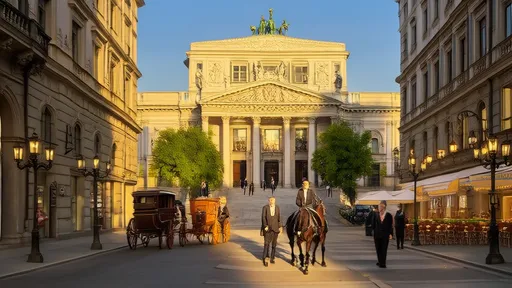
Vienna’s musical landscape is physically defined by its legendary venues. The Vienna State Opera stands as a monument to the city's unwavering devotion to music. Its history is one of both glory and tragedy, having been nearly destroyed during World War II and painstakingly rebuilt to its former neo-Renaissance splendor. To attend a performance here is to participate in a ritual, an event where the art on stage is matched by the grandeur of the surroundings. Similarly, the Musikverein and the Konzerthaus are not mere concert halls; they are temples of acoustical perfection. The Musikverein's Golden Hall, with its gleaming caryatids and rich reverberation, is the iconic home of the Vienna Philharmonic's famed New Year's Concert.
Beyond the well-trodden paths of the classical giants, Vienna nurtured a period of radical innovation at the turn of the 20th century. Composers like Gustav Mahler, who directed the Court Opera, and the members of the Second Viennese School—Arnold Schoenberg, Alban Berg, and Anton Webern—shattered traditional tonality. Their work was often met with public outcry, but it cemented Vienna’s role not just as a guardian of tradition but as a crucible of the avant-garde. This duality—between the comforting embrace of the waltz and the challenging dissonance of atonality—reflects the broader intellectual and cultural ferment of fin-de-siècle Vienna.
In the modern era, Vienna has masterfully balanced its reverence for the past with a vibrant, contemporary music scene. The city’s commitment to music education, through institutions like the University of Music and Performing Arts, ensures a continuous influx of new talent. Meanwhile, venues from the jazz club Porgy & Bess to the eclectic program at the WUK demonstrate that the city's auditory palate is expansive. Electronic music producers, indie bands, and experimental composers all find a home here, drawn by the same creative energy that attracted the masters of old.
The true magic of Vienna's music, however, may lie not in its grand concert halls or famous names, but in its accessibility. It is in the free concerts in city parks during the summer, the strains of a string quartet drifting from a open church door, and the spontaneous gatherings around a pianist in a bustling Heuriger wine tavern. Music here is a democratic pleasure, a shared inheritance that belongs as much to the tourist sipping coffee in a grand café as it does to the seasoned critic at the opera. It is a living, evolving conversation between the city and its sound.
Ultimately, Vienna’s title as a music capital is no accident of history. It is the result of a centuries-long, deeply ingrained cultural obsession. From the imperial courts to the digital age, the city has consistently provided a stage where musical genius can be nurtured, challenged, and celebrated. The waltzes still whirl, the symphonies still thunder, and the quiet melodies still resonate in the city's ancient stones. Vienna does not simply remember music; it continues to live and breathe it, ensuring that its timeless melody plays on for generations to come.

By /Aug 4, 2025
By /Nov 7, 2025

By /Nov 7, 2025

By /Nov 7, 2025
By /Nov 7, 2025
By /Nov 7, 2025

By /Nov 7, 2025

By /Nov 7, 2025

By /Aug 4, 2025
By /Nov 7, 2025
By /Nov 7, 2025

By /Nov 7, 2025

By /Aug 4, 2025
By /Nov 7, 2025
By /Nov 7, 2025

By /Nov 7, 2025
By /Aug 4, 2025

By /Nov 7, 2025
By /Nov 7, 2025
By /Nov 7, 2025
