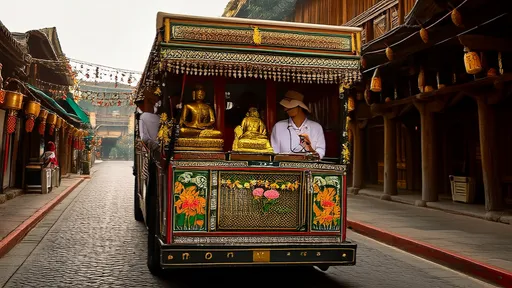
Navigating Chiang Mai’s bustling streets can be an adventure in itself, but for those in the know, the city’s iconic red songthaews (shared taxis) offer an affordable and efficient way to get around. Among the most useful routes for travelers is the 20-baht loop that circles the Old City—a lifeline for both tourists and locals. Unlike the structured bus systems of larger cities, songthaews operate on a loosely coded system of routes and hand signals, creating a unique, if slightly confusing, experience for first-timers.
The 20-baht fare is an unspoken rule for rides within the Old City and its immediate outskirts. Drivers rarely advertise this flat rate outright, but it’s widely understood among regular riders. Haggling isn’t uncommon, especially if you’re heading slightly off the beaten path, but standing your ground with a polite "yeesip baht, kha/khap" (20 baht, please) usually does the trick. The key is confidence—drivers can spot uncertainty and might quote a higher price if you hesitate.
These shared pickups don’t follow fixed schedules or strict routes. Instead, they meander through the Old City’s moat-ringed streets, stopping whenever passengers wave them down. Flagging one is straightforward: simply extend your arm as the truck approaches. If the driver slows, shout your destination—"Tha Phae Gate" or "Wat Phra Singh"—and listen for a quick honk (yes) or a dismissive hand wave (no). The latter usually means the truck is full or heading elsewhere, so don’t take it personally.
Once aboard, you’ll notice the absence of formal stops. To disembark, press the buzzer (often a repurposed doorbell wired near the ceiling) or rap your knuckles loudly against the metal frame. Payment happens upon exiting—hand cash to the driver or pass it forward through other passengers. Small bills are king; drivers rarely carry change for 100-baht notes, let alone larger denominations. The system thrives on trust and efficiency, though newcomers might find the lack of structure unnerving at first.
Locals have developed an entire lexicon of nonverbal cues to streamline the process. A subtle patting motion on the thigh signals a desire to stop, while pointing two fingers downward indicates you’re willing to share the ride with others heading in the same direction. Seasoned riders avoid peak hours (7–9 AM and 4–6 PM) when trucks fill with schoolchildren and office workers, turning the wooden benches into a sardine can of backpacks and elbows.
Beyond practicality, the songthaew culture offers a slice of Chiang Mai’s social fabric. Drivers—often gruff but good-humored—double as impromptu tour guides, shouting out landmarks to clueless foreigners. Passengers swap recommendations for the best khao soi joints or warn each other about overpriced elephant sanctuaries. It’s a mobile community where a monk in saffron robes might share a bench with a tattooed backpacker, both swaying in unison as the truck lurches around a corner.
For those planning to use the service extensively, learning basic Thai directional phrases pays dividends. While many drivers understand tourist hotspots like Nimmanhaemin Road or Maya Mall, lesser-known temples or alleys require clearer communication. A crumpled map or pinned Google Maps location can bridge the gap when words fail. Remember, these trucks aren’t private taxis—detours cost extra, and drivers reserve the right to refuse overly complicated requests.
The 20-baht loop isn’t without its quirks. During heavy rains, some drivers abruptly end their shifts, leaving passengers stranded under awnings. Others might take "creative detours" to drop off a relative or pick up laundry. Such unpredictability is part of the charm, but it’s wise to build buffer time into your schedule. Apps like Grab or Bolt offer predictable alternatives, but at 5–10 times the price, they lack the songthaew’s gritty authenticity.
Environmentalists praise the system’s shared-ride model, though the aging diesel trucks hardly qualify as eco-friendly. Recent talks of electrifying the fleet have stalled due to costs, but some drivers now sport LED signage indicating routes—a small step toward modernization. Purists argue this erodes the system’s improvisational spirit, while pragmatists welcome anything that reduces haggling.
Mastering the songthaew transforms how you experience Chiang Mai. That initial confusion—Is this truck going my way? Did I just overpay?—gives way to quiet pride when you correctly direct a fellow traveler. Soon enough, you’ll develop favorite drivers (look for the one who plays 80s Thai pop) and preferred seating spots (front bench for legroom, rear corners for breeze). It’s a rite of passage, proof you’ve moved beyond the tourist bubble into the rhythmic pulse of daily Thai life.

By /Aug 4, 2025

By /Nov 7, 2025

By /Nov 7, 2025

By /Nov 7, 2025

By /Nov 7, 2025

By /Nov 7, 2025

By /Nov 7, 2025

By /Nov 7, 2025

By /Aug 4, 2025

By /Nov 7, 2025

By /Nov 7, 2025

By /Nov 7, 2025
By /Aug 4, 2025
By /Nov 7, 2025

By /Nov 7, 2025

By /Nov 7, 2025
By /Aug 4, 2025

By /Nov 7, 2025

By /Nov 7, 2025

By /Nov 7, 2025
