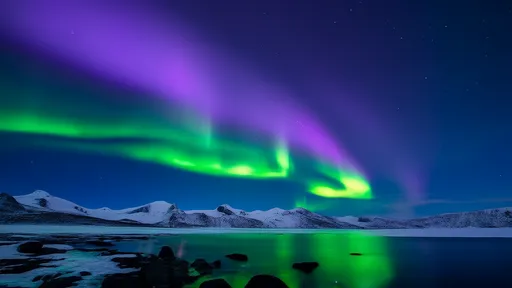
In the heart of the North Atlantic, where fire and ice converge, Iceland offers one of nature's most breathtaking performances. The Aurora Borealis, or Northern Lights, transforms the Icelandic skies into a living canvas of ethereal beauty. Unlike any other celestial phenomenon, these dancing lights have captivated human imagination for millennia, weaving their way into folklore, science, and the very soul of those fortunate enough to witness them.
The science behind the auroras is as fascinating as their appearance. Solar winds carrying charged particles travel millions of miles from the sun to collide with Earth's magnetic field. These particles are funneled toward the poles, where they interact with gases in our atmosphere. Oxygen produces the characteristic green and red hues, while nitrogen contributes shades of blue and purple. The result is a celestial ballet of light that shifts and swirls in patterns that seem almost alive.
Iceland's unique geographical position makes it one of the world's premier destinations for aurora viewing. Sitting just below the Arctic Circle, the island nation finds itself in the perfect sweet spot for Northern Lights activity. From September through April, when darkness prevails for up to 20 hours daily, the stage is set for nature's light show. The country's minimal light pollution outside Reykjavik creates ideal conditions for observing even the most subtle auroral displays.
What sets the Icelandic aurora experience apart is the dramatic backdrop against which these lights perform. Imagine emerald ribbons dancing above steaming geothermal areas, or violet curtains reflected in frozen waterfalls. The lights might shimmer above black sand beaches where icebergs wash ashore, or create otherworldly patterns above volcanic craters dusted with snow. This combination of elemental forces - earth, water, fire, and air - creates a multisensory experience that transcends mere visual spectacle.
The behavior of the auroras remains wonderfully unpredictable. Some nights they appear as gentle, luminous clouds that slowly drift across the starry canvas. Other times, they erupt into frantic coronas of light that pulse and dance with urgent energy. The most intense displays can cover the entire sky, with rays converging directly overhead in what observers describe as standing inside a celestial cathedral. The silence that often accompanies these displays adds to their mystical quality, as if nature is holding its breath in reverence.
Local folklore is rich with interpretations of the Northern Lights. Ancient Icelanders believed they were the reflections from the shields and armor of Valkyries as they led fallen warriors to Valhalla. Some legends suggested the lights were the dancing spirits of departed ancestors, while others warned that whistling under the aurora might invite them down to Earth - with potentially dangerous consequences. These stories, passed down through generations, add layers of cultural significance to the scientific wonder.
Modern aurora chasing in Iceland has become something of an art form. Experienced guides know how to read weather patterns, solar activity reports, and cloud cover predictions to maximize viewing opportunities. The pursuit often involves driving through the night, moving between locations to escape cloud cover, and waiting patiently in thermal clothing as temperatures drop well below freezing. The reward, when the lights finally appear, makes every moment of anticipation worthwhile.
Photographing the Northern Lights requires both technical skill and creative vision. Long exposures reveal colors and details invisible to the naked eye, capturing the full intensity of the display. The best aurora photographs often include foreground elements - a traditional Icelandic turf house, a lone tree bent by Arctic winds, or the distinctive architecture of a country church - to provide scale and context to the otherworldly spectacle above.
Climate change has introduced new considerations for aurora tourism. Warmer temperatures have altered traditional viewing seasons in some years, while changing weather patterns affect cloud cover and visibility. At the same time, increased solar activity cycles have produced more intense and frequent displays, creating a complex relationship between environmental changes and viewing opportunities. Responsible tourism practices have become increasingly important to preserve both the natural environment and the quality of the experience.
The emotional impact of witnessing the aurora often surprises first-time viewers. There's a profound sense of connection to something greater than oneself, a feeling that transcends cultural background or personal belief system. The lights seem to speak directly to the human spirit, reminding us of our place in a vast, beautiful, and mysterious universe. Many visitors describe the experience as transformative, carrying the memory of those dancing lights as a source of inspiration long after they've returned home.
Beyond the visual spectacle, researchers continue to make new discoveries about the Northern Lights. Advanced monitoring equipment has revealed previously unknown patterns in their movement and structure. Scientists now understand more about how different solar events affect the intensity and color of displays. Each new finding adds depth to our appreciation of this natural wonder, blending poetic beauty with scientific marvel.
The future of aurora tourism in Iceland balances preservation with accessibility. As visitor numbers increase, initiatives focus on sustainable viewing practices and education about the cultural and scientific significance of the phenomenon. The goal remains ensuring that future generations can experience the same awe-inspiring displays that have captivated humans for centuries, while protecting the fragile environments where these magical dances occur.
In the end, the Northern Lights represent one of nature's most perfect marriages of art and science. They are predictable in their seasonal appearance yet wildly unpredictable in their daily manifestations. They can be measured and analyzed yet retain an essential mystery that defies complete understanding. For those who stand beneath the Icelandic sky watching these lights dance, time seems to pause, and the ordinary world falls away, replaced by a moment of pure, transcendent wonder.

By /Aug 4, 2025
By /Nov 7, 2025
By /Nov 7, 2025
By /Nov 7, 2025
By /Nov 7, 2025
By /Nov 7, 2025
By /Nov 7, 2025
By /Nov 7, 2025

By /Aug 4, 2025
By /Nov 7, 2025
By /Nov 7, 2025
By /Nov 7, 2025

By /Aug 4, 2025
By /Nov 7, 2025
By /Nov 7, 2025
By /Nov 7, 2025
By /Aug 4, 2025
By /Nov 7, 2025
By /Nov 7, 2025
By /Nov 7, 2025
