In the perpetual twilight of New York City, a rhythm pulses through the asphalt veins, a heartbeat that never truly rests. This is the pulse of the city that never sleeps, a cadence felt not in the quiet of dawn but in the electric hum that persists long after the sun has surrendered to the skyline. It is a force, an entity, a living breath that gives the metropolis its legendary identity.
The transformation begins as the last golden rays of sunset retreat behind the jagged silhouette of skyscrapers. Office windows, once filled with the sterile glow of computer screens, blink out one by one, only to be replaced by the warmer, more intimate lights of apartments and restaurants. The city doesn't empty; it merely changes its occupants. The daytime army of suits and briefcases gives way to a nocturnal congregation of artists, servers, musicians, and dreamers. The tempo of the sidewalks shifts. The hurried, purposeful strides of the day soften into meandering walks, punctuated by laughter that echoes in the canyons between buildings. The air itself seems to change, shedding the crisp, business-like atmosphere for something more sensual, charged with possibility and the faint, sweet scent of street food mingling with exhaust fumes.
This is where the city's true voice emerges. From the depths of the subway, a saxophonist’s mournful melody rides the updraft of warm air to street level, a soundtrack for the night. In hidden jazz clubs in the West Village, the air is thick with the smell of old wood and whiskey, the syncopated rhythm of a bass line felt in the chest as much as heard by the ear. Meanwhile, in the industrial spaces of Bushwick, the ground vibrates with the relentless beat of a DJ, a thousand bodies moving as one under strobe lights. The night is not a monologue but a cacophony of conversations—the clatter of plates from a 24-hour diner, the passionate debate of students in a Harlem coffee shop, the whispered negotiations in the shadowy corners of a Lower East Side bar. Each sound is a thread in the intricate sonic tapestry of the night.
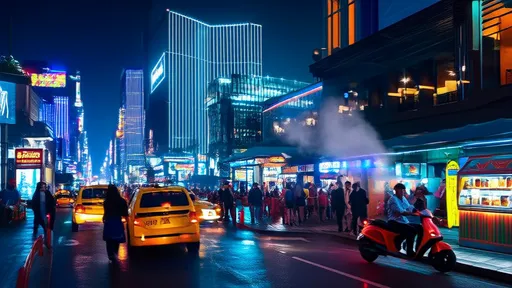
To speak of New York's nocturnal pulse is to speak of its light. This is not the honest, revealing light of day, but an artificial, theatrical glow that paints the city in new colors. The iconic Times Square is its most garish temple, a sensory overload of colossal digital billboards flickering with advertisements for Broadway shows and global brands. The light here is so bright it bleaches the night sky into a perpetual orange haze, turning night into a strange, hyper-real day. But there are subtler illuminations. The soft, golden halo from a bodega, a beacon for those seeking a late-night sandwich or a lottery ticket. The cool, blue fluorescence of an all-night laundromat, where the steady churn of machines provides a hypnotic rhythm. The distant, lonely red beacon of a radio tower atop a skyscraper, blinking steadily like a mechanical heartbeat against the clouds. This landscape of light creates a world without shadows, only depths, shaping the city's character and offering a sense of security and endless activity.
Beneath the feet of the nocturnal wanderers lies another city entirely, one that operates on its own relentless schedule. The subway, often maligned by day, becomes a vital artery at night. Its rumble is a constant, subterranean thunder, a reminder that even when the streets above grow quiet, movement never ceases. The trains, though less frequent, carry a different cargo—night-shift workers with tired eyes, revelers heading home as the first hints of dawn appear, insomniacs riding the lines simply for the motion and the anonymity. Above ground, a parallel economy thrives. Delivery trucks rumble down avenues, restocking shelves for the coming day. Sanitation workers perform their silent, Herculean task of resetting the city, washing away the grime and debris of the previous twenty-four hours. Bakeries begin their alchemy, filling the air with the scent of baking bread that will greet the morning commuters. This unseen labor is the foundation upon which the city's dazzling nightlife is built, the essential, unglamorous work that keeps the pulse from faltering.
The social fabric of the night is woven in these spaces of commerce and community. The corner bodega is more than a store; it is a sanctuary. Its Korean owner knows his customers by name and their usual order. The fluorescent-lit interior is a stage for small, profound human interactions—a cabbie grabbing a coffee, a nurse on a break, a couple arguing softly by the magazine rack. Similarly, the 24-hour diner, with its worn vinyl booths and endless coffee refills, serves as a democratizing hall. Here, a Wall Street banker might sit at the counter next to a bike messenger, both united by a shared need for sustenance at three in the morning. In these spaces, the city's infamous barriers of wealth and status momentarily dissolve. The night fosters a unique brand of intimacy and camaraderie among strangers, bound together by the simple, unspoken understanding that they are all awake while the rest of the world sleeps.
Yet, for all its energy and community, the night also holds a profound solitude. There is a different kind of loneliness that descends after midnight, one that is both oppressive and liberating. Walking through the financial district, where the soaring towers are empty and dark, one can feel incredibly small, a solitary figure in a canyon of silent stone and glass. The constant noise of the city can, in these moments, become a blanket of silence. This solitude is not always negative; it is in these quiet hours that the city becomes a blank canvas for the mind. Writers find their focus, artists their inspiration, and thinkers their clarity. The pressure to perform, to be seen, to keep up, recedes. The night offers the freedom to simply be, anonymous and unobserved, a temporary escape from the relentless gaze of the day.
As the night deepens, pushing towards its own inevitable conclusion, a subtle change occurs. The deep indigo of the sky begins to soften at its eastern edge, leaching into a pale, watery blue. The party-goers have mostly vanished, and the streets belong to a new shift—the newspaper vendors setting up their stands, the first construction crews sipping coffee from paper cups, the delivery bikes beginning their daily dance with traffic. The theatrical lights of the night begin to look pale and artificial against the growing dawn. The city's pulse, which beat so fiercely through the darkness, begins to slow and change its rhythm. It does not stop; it merely prepares for its next incarnation. The hum of the night blends with the growing sounds of the day, a seamless transition that has repeated itself for decades.
The pulse of New York City is not a single, steady beat. It is a complex, polyrhythmic composition of light and shadow, sound and silence, community and solitude. It is the thrum of a bass guitar in a packed club, the quiet conversation in a diner, the rumble of a train under the pavement, and the solitary footsteps of a person walking home alone. It is the promise that no matter the hour, something is always happening, someone is always awake, and life, in all its messy, beautiful, chaotic glory, continues unabated. This ceaseless energy is the city's soul, its greatest myth and its most undeniable truth. To experience it is to understand that New York's true power lies not in its towering structures, but in this relentless, breathing, everlasting pulse that echoes through the endless night.
By /Aug 4, 2025
By /Nov 7, 2025

By /Nov 7, 2025

By /Nov 7, 2025
By /Nov 7, 2025
By /Nov 7, 2025

By /Nov 7, 2025
By /Nov 7, 2025

By /Aug 4, 2025
By /Nov 7, 2025
By /Nov 7, 2025

By /Nov 7, 2025
By /Aug 4, 2025
By /Nov 7, 2025
By /Nov 7, 2025

By /Nov 7, 2025
By /Aug 4, 2025

By /Nov 7, 2025
By /Nov 7, 2025

By /Nov 7, 2025
