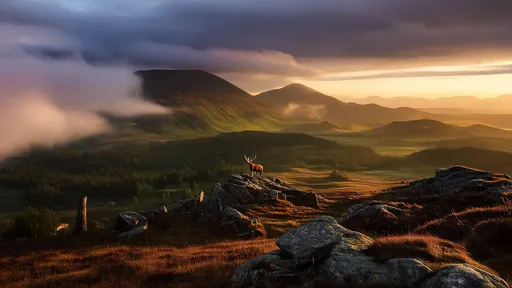
In the misty reaches of northern Britain, where the land rises in rugged splendor and the sea lochs carve deep into the coastline, lies a realm steeped in mystery and legend. The Scottish Highlands have long captured the human imagination, not merely as a geographical location but as a living tapestry woven from centuries of storytelling. Here, the veil between the mundane and the magical feels thin, as if the very landscape breathes with ancient memories. The Highlands are more than mountains and glens; they are the keepers of Scotland's soul, where every stone circle, crumbling castle, and windswept moor whispers tales of heroism, tragedy, and supernatural wonder.
The origins of Highland legends are as old as the hills themselves, rooted in the Celtic and Gaelic traditions that once dominated this rugged terrain. Before the written word became commonplace, stories were the lifeblood of Highland culture, passed down through generations by bards and seanchaidhean (storytellers). These narratives served multiple purposes: they preserved history, imparted moral lessons, explained natural phenomena, and connected communities to their ancestral lands. The dramatic landscape itself became a character in these tales—the brooding mountains were sleeping giants, the shimmering lochs held underwater kingdoms, and the sudden mists were the breath of otherworldly beings.
Among the most enduring figures in Highland folklore are the Fae folk, known in Gaelic as the Sìth. These are not the delicate, winged creatures of Victorian imagination but powerful, often dangerous beings who inhabit a parallel world that occasionally intersects with our own. The Highlands are dotted with "fairy hills" and "fairy glens" where these beings are said to reside. It was believed that certain times of the year, particularly Samhain (Halloween) and Beltane (May Day), were when the veil between worlds was thinnest, and encounters with the Sìth were most likely. Many Highland families maintained traditions to appease these beings, such as leaving offerings of milk or bread, or avoiding building structures on known fairy paths.
No discussion of Highland legend would be complete without the tragic tale of the Kelpies, shape-shifting water spirits most often appearing as magnificent horses. These creatures were said to haunt Scotland's lochs and rivers, luring travelers to a watery doom. The Kelpie legend served as a stark warning about the dangers of Highland waters, particularly to children who might be tempted by the beautiful horse. Yet the Kelpie was not merely a monster; it represented the dual nature of water itself—both life-giving and deadly in the unpredictable Highland environment. Some versions of the legend suggest that if one could manage to place a bridle on a Kelpie, it would become an incredibly powerful servant, though such attempts rarely ended well for the human involved.
The Highlands are also home to more benevolent, though no less mysterious, legendary beings. The Blue Men of the Minch, for instance, were said to inhabit the waters between the Outer Hebrides and the Scottish mainland. These creatures appeared as blue-tinted men who could summon storms and challenge sailors to rhyming contests—losing meant your ship would be dragged beneath the waves. Then there are the Selkies, seals who could shed their skins to become human on land. Selkie stories often revolve around romance and tragedy, typically involving a human who steals a selkie's skin, forcing her to remain on land as his wife, until she eventually finds her hidden skin and returns to the sea.
Historical figures have also been woven into the legendary fabric of the Highlands, their lives embellished with supernatural elements over time. The most famous is undoubtedly Robert the Bruce, whose determination was supposedly inspired by watching a spider repeatedly try to build its web. While this story is likely apocryphal, it has become inseparable from his legend. Then there's the mysterious Brahan Seer, Coinneach Odhar, who lived in the 17th century and whose prophecies—including the prediction of the Highland Clearances—are still discussed today. Whether these figures actually possessed supernatural insight or simply became vessels for collective hopes and fears matters less than their enduring presence in Highland consciousness.
The landscape itself is a central character in Highland mythology. Ben Macdui, the second highest peak in Britain, is said to be haunted by the Am Fear Liath Mòr, or the Big Grey Man. Climbers have reported feelings of being watched, unexplained footsteps, and an overwhelming sense of dread on its slopes. Similarly, Loch Ness needs no introduction, its famous monster having captured global imagination. While Nessie may be the most commercially successful Highland legend, it stands in a long tradition of water creature sightings throughout the region, from Morag in Loch Morar to the each-uisge (water horse) of various other lochs.
The Jacobite risings of the 18th century, particularly the catastrophic defeat at Culloden in 1746, created a new layer of legend in the Highlands. The romantic figure of Bonnie Prince Charlie became the subject of numerous folk tales, including stories of his dramatic escape through the Hebrides with the help of Flora MacDonald. The "Skye Boat Song" immortalizes this journey, transforming historical events into legendary narrative. In the aftermath of Culloden, the Highland way of life was systematically dismantled through the Clearances, when thousands were forced from their ancestral lands. This trauma generated its own legends—stories of ghostly bagpipe music heard on deserted glens, visions of "the great sheep" that displaced communities, and prophecies about the eventual return of the Gaels to their homeland.
Ghost stories naturally abound in a landscape so marked by history and tragedy. Nearly every castle in the Highlands boasts its own spectral residents. Glamis Castle claims multiple ghosts, including the "Grey Lady" and the mysterious "Monster of Glamis." Edinburgh Castle, while technically in the Lowlands, houses the ghost of a piper who disappeared in the tunnels beneath the castle and whose music is still sometimes heard. But beyond these famous locations, humble crofts and remote roads have their own ghost stories—often tales of "fetches" or doppelgangers whose appearance foretells death, or restless spirits unable to leave the land they loved in life.
The survival and evolution of Highland legends into the modern era is a testament to their power. While the Gaelic language has declined, the stories have been translated and adapted, finding new life in literature, film, and music. The novels of Sir Walter Scott in the 19th century played a crucial role in romanticizing the Highlands and preserving certain legends for a wider audience. More recently, the Outlander series has introduced Highland mythology to millions worldwide, blending historical fiction with supernatural elements drawn from authentic folklore.
Today, the legends continue to shape Highland identity and even the local economy through tourism. Visitors flock to supposed fairy glens, monster-spotting locations, and historic sites associated with legendary figures. Some dismiss this as commercial exploitation, but it can also be seen as the latest chapter in the ongoing life of these stories—adapting to new contexts while retaining their essential power. Contemporary Highland artists, writers, and musicians frequently draw on this rich legendary heritage, ensuring the stories continue to evolve rather than becoming frozen relics of the past.
What gives Highland legends their enduring power? Perhaps it is the way they give meaning to a landscape that can be both breathtakingly beautiful and harshly unforgiving. They transform geographical features into narrative landmarks, making the land itself a repository of collective memory. The legends also serve as a form of resistance against cultural homogenization, preserving a distinctive Highland identity even as the world changes around it. In an age of scientific rationalism, these stories remind us that mystery and wonder still have their place in the human experience.
Ultimately, the legends of the Scottish Highlands are not mere superstitions or entertainment—they are the spiritual and cultural inheritance of a people whose history has been marked by both glorious achievement and profound tragedy. They connect modern Scots and visitors alike to the deep past, to the land, and to the universal human need for stories that help us understand our place in the world. As long as the mists continue to gather in the glens and the sea lochs reflect the changing sky, these tales will continue to be told, each generation adding its own layer to the rich mythological tapestry of this remarkable corner of the world.
By /Aug 4, 2025
By /Nov 7, 2025
By /Nov 7, 2025
By /Nov 7, 2025
By /Nov 7, 2025
By /Nov 7, 2025
By /Nov 7, 2025
By /Nov 7, 2025
By /Aug 4, 2025
By /Nov 7, 2025
By /Nov 7, 2025
By /Nov 7, 2025

By /Aug 4, 2025
By /Nov 7, 2025

By /Nov 7, 2025
By /Nov 7, 2025
By /Aug 4, 2025
By /Nov 7, 2025
By /Nov 7, 2025
By /Nov 7, 2025
