There exists a place where the sky has fallen in love with the sea, a place where the celestial blue of the heavens has melted into the brilliant white of sun-drenched villages. This is not a scene from a painter's dream, but the living, breathing reality of the Greek islands, a world that feels spun from the threads of an ancient myth. For generations, travelers have journeyed here, not merely for a holiday, but for a pilgrimage to a landscape that has come to define a certain kind of beauty—one that is both starkly simple and profoundly complex.
The iconic image of Greece, the one that adorns countless postcards and travel magazines, is a symphony in two colors: blue and white. To the casual observer, it is a charming aesthetic choice. But to understand it is to delve into a story of history, nature, and national identity. The story begins not with an artist's whim, but with a mandate. In the late 1960s, during the military junta, a law was passed decreeing that all buildings on the islands must be painted white. The official reason was one of public health, as white limewash, a mixture of slaked lime and water, was believed to have disinfectant properties. This practice, known as whitewashing, was already a tradition in the Aegean, a way to protect houses from the relentless summer sun and to keep interiors cool.
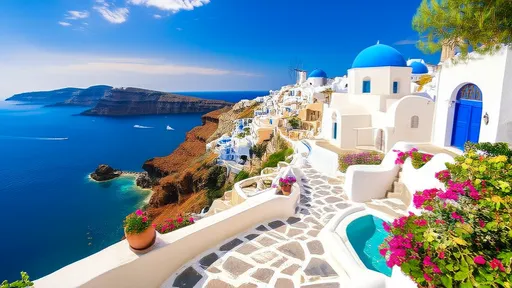
Yet, the true magic of this mandate was unintentional. It created a visual unity, a canvas of such purity that it made the other colors of the landscape sing with newfound intensity. Against this brilliant white backdrop, the blues of the world became almost overwhelming. The domes of the churches, traditionally painted blue, were no longer just architectural features; they became focal points, earthly representations of the sky and sea that surrounded them. The specific shade of blue, a deep, vibrant cobalt, was often made from a mixture of lime and loulaki, a blue powder pigment. This was not a standardized color from a can, but a living hue that would fade and be reborn with each annual whitewashing, its intensity shifting with the light and the season.
Walking through the labyrinthine streets of villages like Oia in Santorini or Mykonos Town, one is enveloped in this monochromatic dream. The sunlight here is a character in itself. It does not merely fall; it dances. It ricochets off the whitewashed walls, filling every narrow alley with a luminous, ethereal glow. Shadows are sharp and defined, carving out the cubist forms of the houses and staircases. The air itself seems to shimmer, charged with a clarity that is almost intoxicating. This interplay of light and form is a photographer's paradise, but it is also a deeply sensory experience. The whiteness amplifies the light, creating an environment that feels both expansive and intimate, a private world bathed in celestial brilliance.
And then, there is the blue. It is not a single blue, but a thousand shades, each more breathtaking than the last. From the turquoise shallows lapping at the feet of volcanic cliffs to the deep, inky indigo of the open Aegean, the sea is a living tapestry. The sky, often devoid of even a wisp of cloud, presents a blue of such profound depth that it feels like a solid thing, a dome of lapis lazuli. The church domes and wooden shutters provide the perfect intermediary, the human-made echoes of this natural splendor. This is the core of the Greek aesthetic: it is not an imposition of color upon nature, but a reflection of it. The architecture humbly holds up a mirror to the sky and the sea, creating a seamless harmony between the built environment and the wild, majestic landscape.
This blue and white world is far from sterile or monotonous. It is a stage upon which life unfolds with vibrant passion. The starkness of the color palette makes every other hue pop with dramatic effect. The brilliant pink of a bougainvillea vine tumbling over a white wall is a joyous explosion of color. The vibrant green of a prickly pear cactus or a solitary olive tree stands as a testament to tenacious life. In the evenings, the white walls become a canvas for the sunset, blushing in shades of rose, gold, and fiery orange as the sun dips below the horizon. This daily spectacle is a reminder that while blue and white provide the foundation, the Greek world is filled with a spectrum of emotions and colors.
Beyond the visual poetry, this color scheme is a testament to a philosophy of life forged in a demanding environment. The simplicity is born of necessity. The Cycladic architecture, with its cubic forms, flat roofs, and small windows, is a direct response to the elements—the fierce summer heat, the strong meltemi winds, and the scarcity of building materials. There is a profound wisdom in this simplicity. It speaks of a culture that has learned to prioritize what is essential, to find beauty in utility, and to create comfort through intelligent design. The cool, thick walls and the airy, uncluttered interiors offer a sanctuary from the external world, a lesson in how to live well with less.
Today, the blue and white motif has transcended its origins to become a global symbol. It represents not just Greece, but an ideal of summer, freedom, and a life lived in harmony with nature. It is a powerful brand, evoking a sense of escape and timeless beauty. For the visitor, to be immersed in this world is to experience a form of sensory recalibration. The constant noise of modern life, both literal and visual, falls away. The mind, accustomed to a thousand competing stimuli, is allowed to rest, soothed by the rhythmic sound of the sea and the serene, uncluttered landscape. It is a place that invites introspection and inspires a slower, more mindful way of being.
Ultimately, the Greek blue and white world is more than just a picturesque destination. It is a living landscape that tells a story of adaptation, resilience, and a deep, abiding connection to the natural world. It is a place where history is written not in books, but in the layers of whitewash on a village wall and the ever-changing blue of the sea. It is a testament to the idea that the most powerful beauty is often the simplest, and that true luxury can be found in a sun-drenched courtyard, a splash of cobalt against a field of white, and the endless horizon where the sky meets the sea. To visit is to step into a fairy tale, one that is beautifully, wonderfully real.

By /Aug 4, 2025
By /Nov 7, 2025

By /Nov 7, 2025
By /Nov 7, 2025
By /Nov 7, 2025
By /Nov 7, 2025

By /Nov 7, 2025
By /Nov 7, 2025

By /Aug 4, 2025
By /Nov 7, 2025
By /Nov 7, 2025
By /Nov 7, 2025

By /Aug 4, 2025
By /Nov 7, 2025
By /Nov 7, 2025
By /Nov 7, 2025
By /Aug 4, 2025

By /Nov 7, 2025

By /Nov 7, 2025
By /Nov 7, 2025
