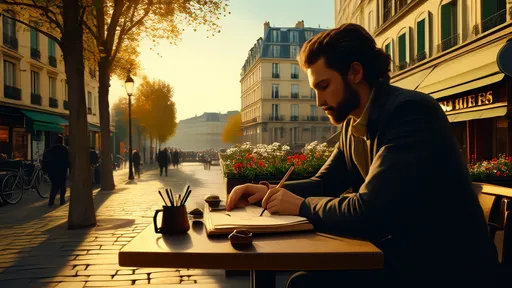
There exists a certain magic along the banks of the Seine, a palpable energy that has drawn dreamers, thinkers, and creators for centuries. This is the Parisian Left Bank, or Rive Gauche, a place where time seems to move differently, measured not by the ticking of clocks but by the stroke of a brush, the scribble of a pen, and the slow, deliberate sip of an espresso. To walk through its winding streets is to step into a living, breathing museum of modern art and literature, a district where the ghosts of Hemingway and Picasso feel as present as the students hurrying to their lectures at the Sorbonne.
The very air of the Left Bank carries the weight and wonder of its history. For generations, it has served as the unofficial capital of the artistic world, a sanctuary for those who dared to see the world anew. In the smoky, dimly lit cafes of Saint-Germain-des-Prés, existentialism was born over countless cups of coffee and heated debates. Jean-Paul Sartre and Simone de Beauvoir held court at Les Deux Magots, their ideas about freedom and existence spilling out onto the boulevard and forever changing the landscape of philosophy. Just a stone's throw away, at the Café de Flore, a young Albert Camus might have been found, sketching out the absurdist contours of a world still reeling from war. These were not just places to eat and drink; they were incubators for revolutions of the mind, their tables serving as desks, their terraces as public salons.
This legacy of intellectual fervor is inextricably linked to the neighborhood's academic heart, the Latin Quarter. The name itself, dating back to the Middle Ages when Latin was the lingua franca of scholars, hints at its enduring purpose. The University of Paris, one of the world's oldest, has anchored this area for over eight centuries, ensuring a constant influx of youthful energy and insatiable curiosity. The narrow, cobbled streets around the Sorbonne are a labyrinth of bookshops, their shelves bowing under the weight of philosophical treatises, avant-garde poetry, and forgotten novels. Here, the past and present of the written word coexist. You can feel it in the quiet concentration of a student hunched over a text in the shadow of the Panthéon, and in the animated discussions spilling from the open doors of tiny, packed bars. The art of conversation is not dead here; it is the neighborhood's lifeblood.
Of course, the artistic soul of the Left Bank is not confined to the page. It explodes into color and form in the countless galleries and legendary studios that dot the landscape. The story of modern art is, in many ways, a story written here. In the early 20th century, the area of Montparnasse usurped Montmartre as the epicenter of the art world. It was a chaotic, vibrant, and poverty-stricken paradise for artists who would later become household names. In dilapidated studios like La Ruche, or "The Beehive," a young Marc Chagall, Amedeo Modigliani, and Chaim Soutine lived and worked in close quarters, trading ideas, critiques, and sometimes a loaf of bread for a sketch. They gathered at La Coupole, La Rotonde, and Le Dôme, cafes that served as their living rooms, offices, and galleries. It was in these spirited, often desperate environments that Cubism was refined, Fauvism found its voice, and the School of Paris was born. The walls of these establishments, if they could talk, would tell tales of fierce arguments, profound breakthroughs, and the unbreakable camaraderie of creation.
This rich history is not a relic to be viewed behind glass; it is a living tradition that continues to evolve. While the names and faces have changed, the creative impulse remains as strong as ever. Contemporary art galleries nestled in the side streets of Saint-Germain showcase the work of today's visionaries, often drawing direct inspiration from the giants who walked these same pavements. Small, independent cinemas screen films that challenge and provoke, continuing the Left Bank's tradition of intellectual dissent. The Marché de la Création on Boulevard Edgar Quinet, held every Sunday, is a testament to this enduring spirit. Here, amidst the smell of oil paint and fresh canvas, emerging artists hang their work for the world to see, engaging in the same hopeful, vulnerable act as their predecessors did a hundred years prior. The baton of creativity has been passed, and a new generation is now running with it.
To truly understand the art of the Left Bank, one must also understand its relationship with the simple, daily rituals of life. Art here is not separate from existence; it is woven into its very fabric. It is found in the careful arrangement of pastries in a patisserie window, a still-life worthy of Cézanne. It is in the elegant, timeless fashion of a woman cycling past the Luxembourg Gardens, her scarf fluttering in the wind like a Duchamp nude. It is in the sound of an accordion player on a bridge, his melody a perfect, fleeting composition. The entire neighborhood operates on an aesthetic principle, where beauty is not an luxury but a necessity. This is why the Left Bank has never lost its allure. It offers a way of life, a philosophy that values the quality of a moment, the depth of an idea, and the beauty of a form above all else.
Ultimately, the art of the Left Bank is an art of the spirit. It is a mindset that champions the individual voice, celebrates the unconventional, and finds profound meaning in both grand philosophical systems and the quiet contemplation of a single flower. It is a place that reminds us that art is not merely something to be looked at, but something to be lived. It is in the courage of the writer facing the blank page, the passion of the painter confronting the empty canvas, and the quiet determination of all who believe that they can add something new and beautiful to the world. The light that attracted the great masters and thinkers of the 20th century still shines on the Rive Gauche. It is a soft, golden light that seems to illuminate not just the elegant stone buildings and chestnut trees, but the very possibilities of the human imagination.
By /Aug 4, 2025
By /Nov 7, 2025
By /Nov 7, 2025

By /Nov 7, 2025
By /Nov 7, 2025
By /Nov 7, 2025
By /Nov 7, 2025
By /Nov 7, 2025
By /Aug 4, 2025
By /Nov 7, 2025
By /Nov 7, 2025

By /Nov 7, 2025
By /Aug 4, 2025
By /Nov 7, 2025
By /Nov 7, 2025

By /Nov 7, 2025
By /Aug 4, 2025
By /Nov 7, 2025
By /Nov 7, 2025
By /Nov 7, 2025
